
An yeqi
Science E-portfolio

Internet
I learnt many things from the Internet about Science. However, I would like to highlight one of the things I learnt that really fascinated me and it is Einstein's famous equation E=MC2. Below is a video showing Einstein talking about his theory.
E=MC2

Still confused??? Below is another video that I think it explained the theory very well.
E is energy, m is mass, and c is the speed of light. Thus, the equation E=MC2 is also equal to Energy=mass x speed of light squared. It means that the equation E = mc2 indicates that energy always exhibits relativistic mass in whatever form the energy takes. One of Einstein's great insights was to realize that matter and energy are really different forms of the same thing. Matter can be turned into energy, and energy into matter. For example, For example, consider a simple hydrogen atom, basically composed of a single proton. This subatomic particle has a mass of
0.000 000 000 000 000 000 000 000 001 672 kg
This is a tiny mass indeed. But in everyday quantities of matter there are a lot of atoms! For instance, in one kilogram of pure water, the mass of hydrogen atoms amounts to just slightly more than 111 grams, or 0.111 kg.
This is a very small mass. Einstein's equation shows us the amount of energy this mass would be equivalent to, if it were all suddenly turned into energy. To find the energy, you multiply the mass by the square of the speed of light. The speed of light is 300,000,000 meters per second:
= 0.111 x 300,000,000 x 300,000,000
= 10,000,000,000,000,000 Joules
This is a lot of energy! One Joule is about the energy released when you drop a textbook to the floor. But the amount of energy in 30 grams of hydrogen atoms is equivalent to burning hundreds of thousands of gallons of gasoline! Speaking of which, using this equation we can produce a lot of energy. Thus, we can use this amount of energy to cause mass destruction but we can also use it to produce electricity.



Atomic Bomb
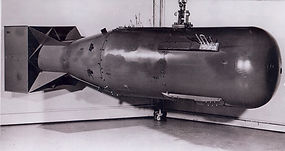


Weapons of Mass Destruction
The atomic bomb releases great quantities of energy through a process called nuclear fission, or 'splitting', of a large unstable (radioactive) element like uranium or plutonium.
Uranium or plutonium are very unstable; every atom's nucleus is ready to fall apart ('decay') at the slightest nudge, releasing unneeded energy and extra neutrons. In the diagram besside this sentence, the plutonium (B) is given that nudge by the outer casing of TNT (A), which explodes all around it.
This process is called 'Nuclear Fission'.
The plutonium is unstable, or radioactive. Its atoms are constantly 'falling apart', breaking up into smaller elements that are more stable. Every time one nucleus does this, it releases the extra energy it no longer needs to hold it together, as well as a few left-over neutrons. This energy, and the escaping neutrons, is what we describe as the radiation being emitted from the radioactive plutonium. Enough atoms in the chunk of plutonium are breaking down at any one time to make the chunk of plutonium warm up, but not enough to be considered an explosion.
What happens in the bomb, however, changes that! The force of the TNT explosion causes the plutonium to be squashed, or compressed in size, and become very dense. This is called its 'critical mass'; the plutonium is now so densely packed together that the neutrons escaping from the decaying nuclei of plutonium cannot escape from the plutonium without bumping into another plutonium atom!
When they hit another atom, they cause that nucleus to break down too, whether it was ready to or not. That second nucleus releases more energy, and more neutrons, which in turn go on to hit and break up further nuclei. The decaying nuclei cause more decaying nuclei, and so on, in a rapidly escalating chain reaction ... and all because the plutonium has been squeezed into such a dense state (by the TNT) that the escaping neutrons that normally would fly out of the material now can't, without hitting other nuclei!
Within a very tiny fraction of a second, all the nuclei in the chunk of plutonium have been hit by escaping neutrons, and have broken down. The extra energy in trillions of atomic nuclei is all released at once!
The nuclear fusion process
The block of deuterium and tritium atoms are squeezed into a super-dense mass by the exploding atomic triggers. Nuclei of these two isotopes are squeezed together by the force of the explosion.
The force is so great that it causes the nuclei to combine. This process is called nuclear fusion.
A new nucleus is formed ... helium.
But this new nucleus requires less energy to keep it together, and there is one less neutron needed. This excess energy, and the neutron, escape as radiation.
The amount of escaping energy is huge; bombs of this type can release energy equivalent to the explosion of many millions of tons of TNT.
The escaping neutrons also cause the uranium in the bomb casing to undergo a fission chain reaction, the energy from which is added to the total output of the bomb. It also results in much radioactive material being expelled into the atmosphere, which can later descend as 'fallout', and kill living things. Bombs without the uranium casing just release a lot of energy and neutrons, killing in the immediate vicinity without leaving a lot of radioactive fallout.


And the Hydrogen Bomb

There is a much more powerful bomb. It not only release much more energy, using a process called 'nuclear fusion', but it is also triggered not by TNT, but by an atomic bomb! The central core (B) is a mass made up of trillions of two kinds of atoms, which are both isotopes of hydrogen, called deuterium and tritium. (These are just hydrogen atoms with one or two extra neutrons in each nucleus). Small atomic bombs (A) scattered around the outside cause the deuterium and tritium to be squeezed into a very dense mass, which initiates a process called nuclear fusion, releasing great quantities of energy.As the core explodes, it causes the bomb casing, which is made from uranium, to undergo fission, creating even more energy. In other words, an atomic bomb sets off a fusion bomb, which also triggers another atomic bomb!